
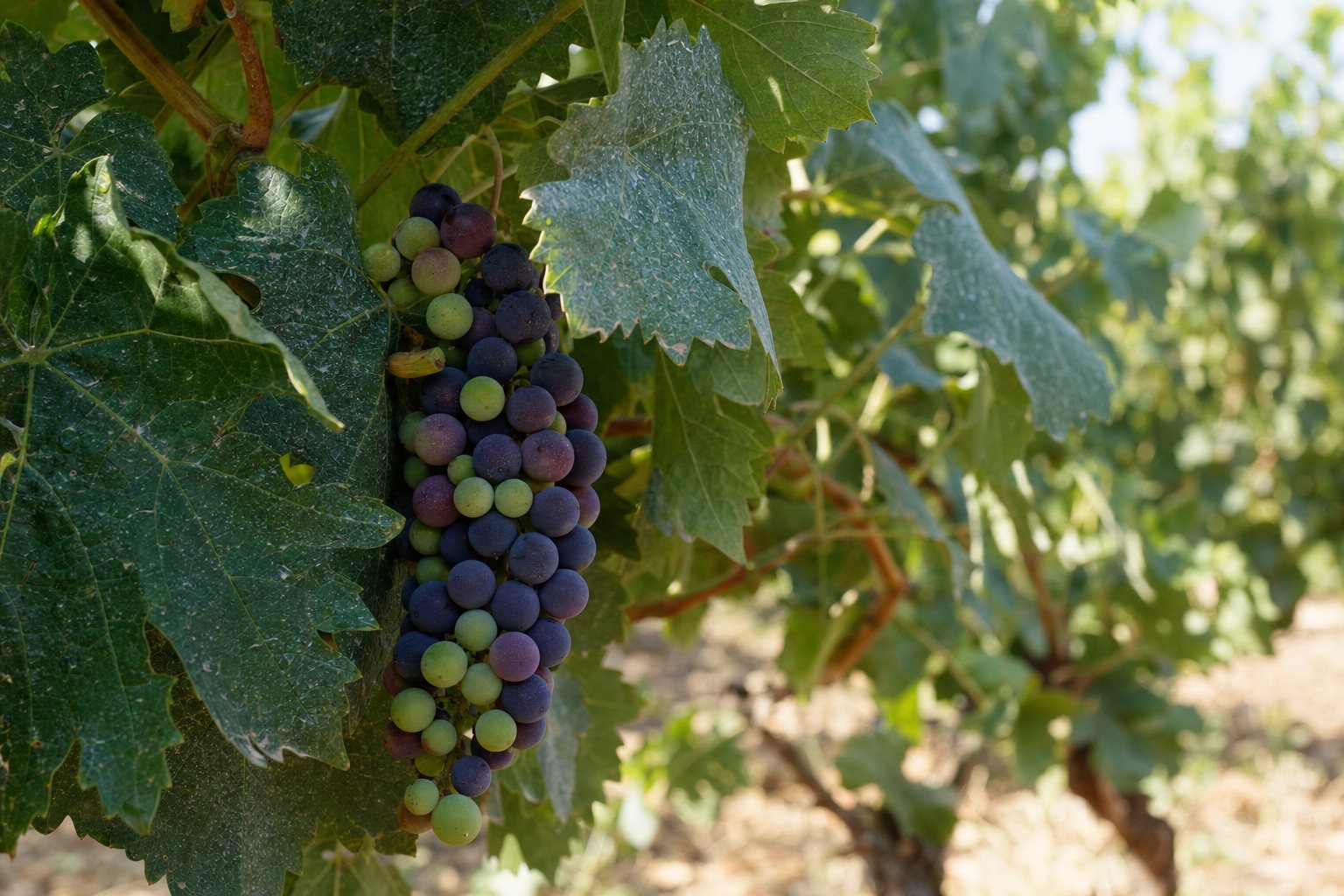
July is the month when the vineyard slows down. After weeks of fast growth, the vine stops stretching out and puts its energy into the bunches. The shoots stop growing. The leaves harden. And the berries begin to change.
It is a phase of transition. The canopy no longer needs the same work as in June. But what happens now — quietly, inside every bunch — shapes the character of the wine we will make in a few months’ time.
Veraison: the moment the grapes change
Between the second and third week of July, depending on the variety and the season, veraison begins. It is the shift from the green phase to the ripening phase. In red grapes you can see it clearly: the colour turns from green to purple, first in patches, then evenly. In white grapes the change is less obvious but it is there: the skin becomes slightly translucent, and the berry loses the hardness it had just a few days earlier.

Veraison does not arrive all at once. In the same row there can be bunches already ripening and bunches still completely green. Even within the same bunch, the berries do not all change on the same day.
Here, Sangiovese and Syrah are almost always the first to go through veraison. Montepulciano is the slowest. Merlot sits in the middle. Among the whites, Malvasia Puntinata is early and Trebbiano comes last. Grechetto follows its own timing, which is often unpredictable.
At this stage we do not intervene. We watch. Every day spent between the rows helps us understand how ripening is progressing and gives us an idea of when the harvest might start. It is too early to decide anything, but it is not too early to observe.
Water stress: a dry-farmed vineyard under the July sun
July in Santa Palomba is hot. Temperatures often go above thirty-five degrees. Rain is rare and when it comes it does not last long. The surface of the soil is dry and hard.
We do not irrigate. We never have. Our vines are dry-farmed and their roots, after decades, have gone deep enough to find the moisture they need. The volcanic, pozzolanic soil helps us: it holds water in the deeper layers and releases it slowly. The surface dries out, but underneath the vine still finds what it needs.
Moderate water stress is not a problem. It is a tool. When the vine has less water available, it concentrates sugars and aromas in the berries. The skin thickens slightly, which in reds means more colour and more structure. In whites it means crisper acidity and more defined aromas.
We walk the vineyard in the coolest hours — early in the morning and late in the afternoon — to check on the vines. We look for signs of suffering: wilting leaves, soft berries, bunches exposed to direct sun with no leaf cover. If the leaf thinning done in June was balanced, the bunches have enough shade not to get scorched but enough air not to rot.
Thinning: stepping in only when needed
The problem arises when stress becomes excessive. If temperatures stay high for too long without any rain, the vine closes its stomata and stops working. The leaves curl, ripening stalls, and the berries can dry out. In that case we have to step in with thinning.
Thinning is a hard choice. It means cutting off healthy grapes and dropping them on the ground. For anyone who works the vineyard all year round, it is a gesture that takes a mental toll as well. But at certain times it is necessary.
A vine with too many bunches, in extreme conditions, cannot ripen them all evenly. It spreads its energy too thin, slows down and produces mediocre grapes. Removing part of the crop lets the vine focus everything on what is left. Fewer bunches, but better ones.
How much fruit to remove changes every year and from vine to vine. There is no fixed rule. We look at the vigour of the vine, the amount of leaves, the number and size of the bunches. Then we decide. Always by hand, always bunch by bunch, always variety by variety.
Thinning, when needed, is the last big manual job before the harvest. After that, the vineyard will go its own way with what we have left it.
Treatments: less frequent, more targeted
In July, disease pressure eases. The dry heat removes the risk of downy mildew, which needs moisture to develop. Powdery mildew, on the other hand, stays active and latent, and in some cases becomes the main problem.
We keep treating with sulphur, especially in the first half of the month, when temperatures are not yet too high. In extreme heat we have to be careful: sulphur in high summer can burn leaves and berries if it is applied at the wrong time of day. We only treat very early in the morning, while the temperature is still bearable.
We use copper only if the weather calls for it. A sudden summer storm can bring back the humidity and reopen the risk of downy mildew. But in general July is the month when treatments become fewer. The vineyard is less vulnerable than it was in May and June. The canopy is mature, the leaves are tougher, and the bunches are starting to have thicker skins.
We stay below the annual copper limits set by the organic regulations. This is the result of careful management in the previous months: having treated well in spring allows us to ease off now.
The cellar waits
In the cellar, July is a quiet month. The whites are in bottle. The reds continue ageing in steel. There is nothing urgent to do.
It is the time when we clean and prepare everything for the approaching harvest. We check the tanks, test the equipment and make sure everything is ready for when the first grapes arrive. Late August and September seem far away, but you have to reach them well prepared in the cellar. Once the harvest starts there is no time to fix what does not work.
We also do the last tastings of the reds to see where they stand. Some may be ready for bottling at the end of the summer. Others will need a few more months. Every wine follows its own time.
July as a month of patience
Work in the vineyard slows down. Not because there is nothing to do, but because the vine needs space. After months of work — pruning, tying, leaf thinning, topping, treatments — the vine now has to work on its own. We can only check that everything is going well and step in if something goes wrong.
It is a month of heat and waiting. The days are long, the sun beats down, the ground is dry. But inside every bunch something is happening that you cannot see: sugars rise, colours change, acids rebalance. Ripening is a slow process that cannot be rushed.
This too is part of making wine. Accepting that there are times when the best work is to do nothing. Standing still, watching, trusting the work done before. Every year July reminds us that patience is not the opposite of work. It is the hardest part of it. And sometimes not acting is the right choice.