
June is the busiest month of the year. Flowering is over, the tiny berries are forming and the vines are growing at a pace that leaves no room for delay. In just a few days the shoots gain tens of centimetres. The canopy thickens. And we have to keep up with all of it.
This is when work in the vineyard becomes daily. There are no breaks, no empty days. Every morning we go out between the rows and decide what to do based on what we see.

Fruit set: when the flower becomes a berry
In early June flowering gives way to fruit set. The fertilised flowers start turning into small green berries, hard and compact. The unfertilised ones drop. It is a natural selection process that the vine carries out on its own.
How fruit set turns out depends on how flowering went. If conditions were favourable — stable temperatures, little rain, moderate wind — the share of flowers that set is high and the bunches will be even. If something went wrong, you see loose bunches, with sparse berries spread unevenly.
Here in Santa Palomba we check fruit set variety by variety. Malvasia Puntinata is the most delicate: it takes very little for the bunches to turn out loose. Grechetto is more regular. Among the reds, Montepulciano tends to produce compact bunches, which calls for attention in the following months, because a bunch that is too tight holds moisture and becomes vulnerable. Syrah and Merlot behave more predictably.
At this stage we do not touch the bunches. We observe and take note. Any decisions on thinning will come later, when we have a clearer picture of the crop load.

Canopy management: leaf thinning and topping
In June the vines grow fast. The shoots lengthen, the leaves multiply, the canopy tends to close up. Without intervention, the rows become solid green walls where air does not circulate and light does not get through.
Topping is the first job. We cut back the tips of the shoots that grow past the last support wire, and a small part of the canopy wall. It is a job repeated several times during the month, because the growth does not stop. Topping keeps the canopy in check, stops the shoots from falling back down and creating shade, and steers the vine’s energy towards the bunches rather than towards leaf growth.
Then comes leaf thinning. We remove leaves around the bunches, especially on the east side of the row, the one exposed to the morning sun. The aim is twofold: to improve airflow and to let the crop protection treatments reach the bunches without obstacles.
We do not thin aggressively. We only remove the leaves that need to go. A bunch fully exposed to the July and August sun risks scorching. A bunch too covered risks rot. The right balance is found vine by vine, row by row.
These are two jobs where we can get some help from machines. They come so close together and are so demanding that doing them only by hand would be impossible for us. They are operations that take time. They cannot all be done at once and they cannot be put off. A delay of a few days in June means catching up on twice the work the following week.
Treatments: the highest pressure of the year
June is the month when crop protection needs the closest attention. The canopy is dense, temperatures rise, and summer storms bring sudden humidity. These are ideal conditions for downy and powdery mildew.
We keep treating with copper and sulphur, as the organic regulations allow. But at this time of year our attention increases. After every significant rainfall we assess whether the protection is still effective or whether we need to treat again. The growth since the previous treatment also tells us whether it is time to step in.
Copper protects against downy mildew infections. But copper only works if it is already on the leaf when the rain arrives. Afterwards it is too late. That is why in June we check the weather forecast with almost obsessive attention. A treatment applied twenty-four hours before a storm can save the day. The same treatment applied the day after is useless.
Sulphur against powdery mildew works well with June temperatures. The heat helps evaporation and sublimation, and therefore the effectiveness of the product. But the hottest hours of the day have to be avoided so as not to risk damaging the leaves. We treat early in the morning, while it is still dark, or late in the afternoon as darkness approaches. At those times there is also no wind, and since it is a powder treatment, at this stage that is an essential condition for working safely.
Doses stay low. A well-managed canopy — thinned, topped, airy — allows us to use less product with better results. That is the advantage of constant work in the vineyard: crop protection, even when organic, works better on a tidy vineyard.
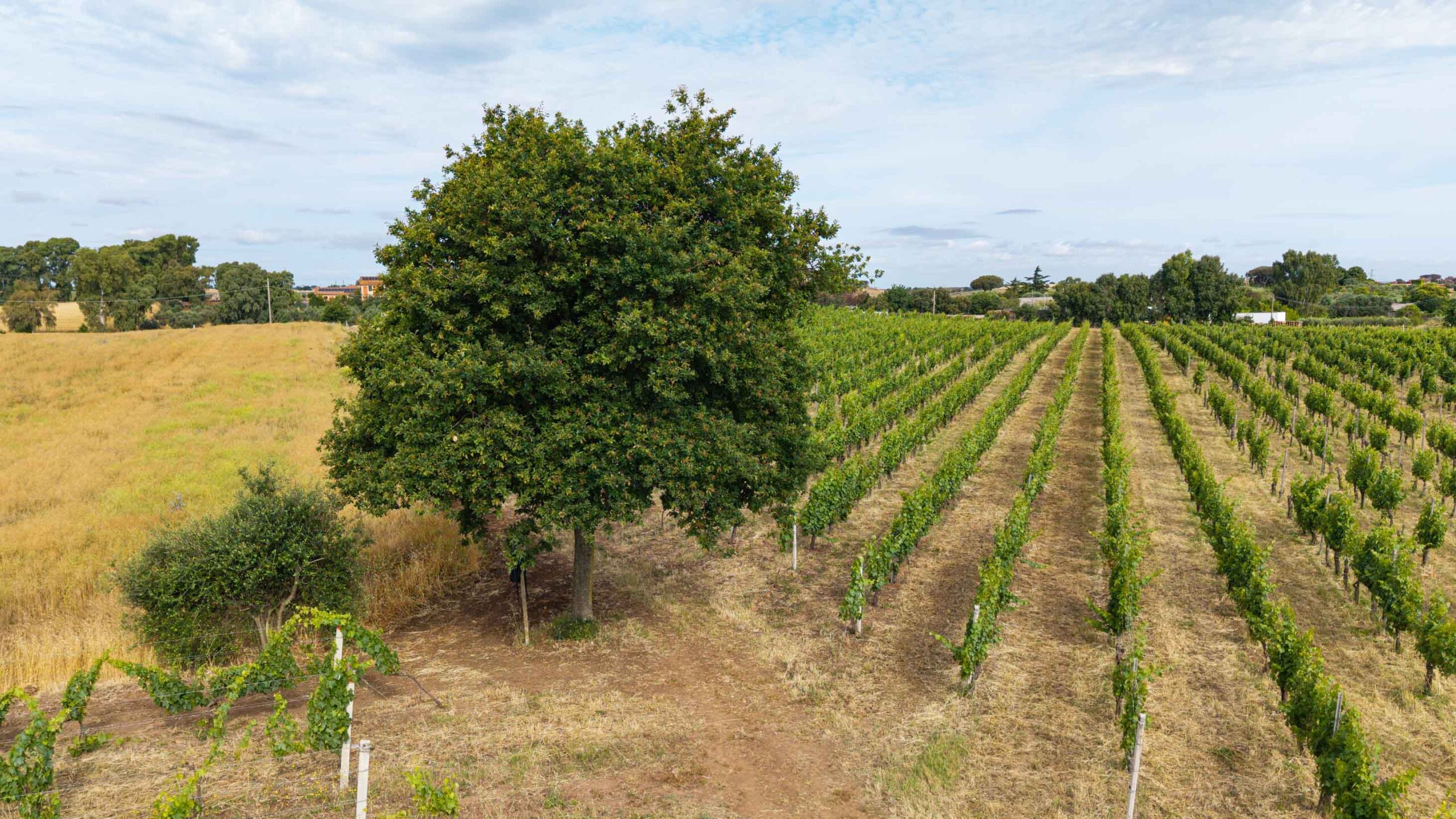
The soil in summer
When the heat arrives, the soil behaves differently. Spring rains become fewer and the surface starts to dry out. The pozzolanic structure of our soil holds moisture deep down and releases it slowly to the roots. This is an important advantage in a month like June, when the vine needs water to sustain leaf growth and the development of the bunches.
We do not irrigate. Our vines are dry-farmed. Over thirty years and more, the roots have gone deep and found their balance with the volcanic soil. In periods of water stress the vine naturally slows down. That is not a problem. It is a mechanism that contributes to the quality of the grapes.
In the cellar: the reds and the last checks on the whites
While the vineyard demands all our energy, work in the cellar goes on at a different pace. The whites bottled in May are resting. We let them rest in bottle before putting them on sale.
The reds from the 2025 harvest are still in steel. In June we carry out the racking needed to separate the wine from the lees that have settled at the bottom. It is a simple but important operation: racking at the right time keeps the wine clean without the need for aggressive filtration.
We taste regularly. We follow how each tank is evolving. Some wines are almost ready, others need time. We are in no hurry. The reds will be bottled when the wine tells us it is time.
June as a month of endurance
There is no other way to describe it. June is the month you endure. The days are long, the heat starts to be felt, the work is non-stop. The vineyard does not wait. It grows, it gets sick, it bears fruit. All at the same time.
But it is also the month when you see the difference between a vineyard that is cared for and one left to itself. Airy rows, visible bunches, a tidy canopy: they are the result of six months of work now taking shape.
We are not looking for perfection. We are looking for balance. Between what the vine wants to do and what we can do. Between the vineyard and the cellar. Between work and waiting. June reminds us that making wine is above all a matter of being present. Being here, every day, watching and deciding.