

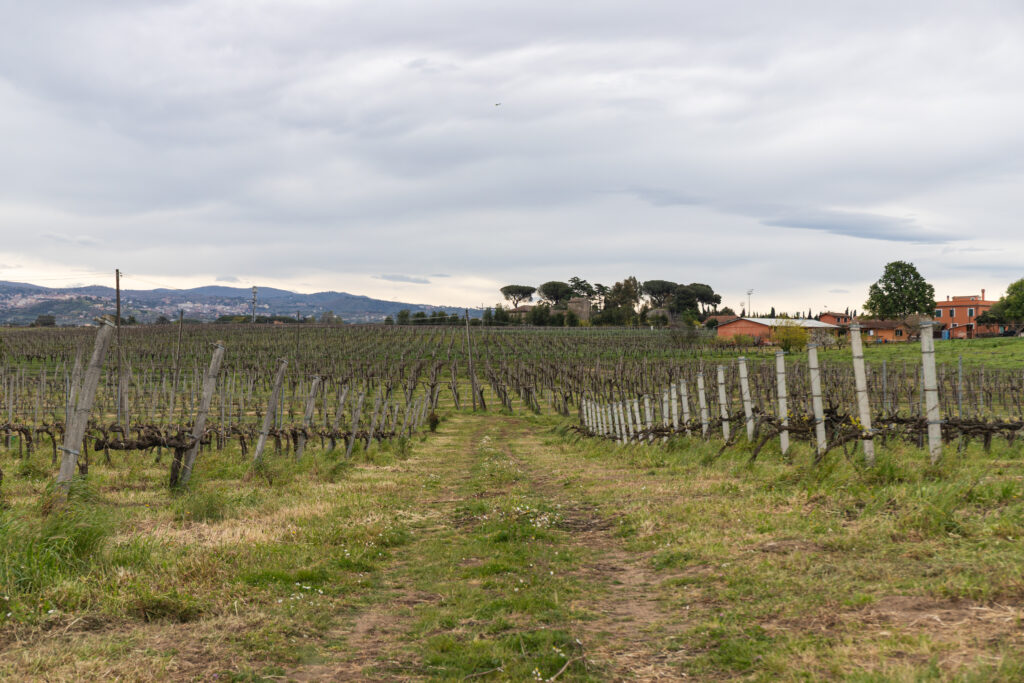
April is the month when everything changes. The vineyard stops being a drawing of wood and wire and becomes something alive. The buds open, the shoots emerge, and from this moment every day counts.
For us it is the most important turning point of the year. Everything we did from December to March — pruning, tying, checking the posts — is now put to the test. If the winter work was done well, the restart is orderly. If something is off, April shows it without mercy. And we treasure every mistake so as not to repeat it in the future.

Budbreak is not the same for everyone
Every variety has its own timing. There is no fixed date when the vineyard restarts. It depends on the variety, the exposure of the row, the trend of temperatures in the preceding weeks and the type of soil.
Here in Santa Palomba the first to move are usually the white varieties: Malvasia Puntinata and Grechetto are almost always early. Trebbiano follows close behind. Among the reds, Merlot and Sangiovese are the earliest, while Montepulciano takes a few more days. Syrah sits in the middle.
This difference is not a problem. It is the natural rhythm of things. We adapt; we don’t try to make everything uniform. We observe each row and step in when needed, not before.

The first inspections among the rows
In April we spend a lot of time walking the vineyard. Not to carry out big operations, but to look. We check how the shoots are developing, whether they are evenly distributed along the cane.
We also look at the soil. The volcanic soil of this area drains spring rain well, but after a wet winter it’s still worth checking there is no standing water in the lower spots. The structure of the soil — pozzolanic, mineral, with a good balance of sand, silt and clay — is a natural advantage. But it is not an automatic guarantee. Every year is different.
At this stage we want to understand the general state of the vineyard. We don’t act on the canopy, which is still too young. We record what we see and plan the next steps.
The first treatments: copper and sulphur
With the restart of growth, the crop-protection treatments also begin. We have been certified organic since 2004 and our tools are the usual ones: copper and sulphur.
We do the first treatment when the shoots reach a sufficient length, usually around ten centimetres. We never anticipate. A treatment that is too early is useless. One that is too late leaves you chasing — often in vain — for the whole season.
Copper protects against downy mildew. Sulphur against powdery mildew. They are two different fungi, with different conditions for development, but both can become a serious problem if you don’t act at the right moment.
The doses we use are low. This is possible because we work on a vineyard tended all year round: balanced pruning, correct tying and airy rows reduce the conditions that favour fungi. The chemical treatment, even if organic, is never the first tool. It is the last.
April weather in the Agro Romano
April here is an unstable month. Warm days alternate with returns of cold. Rain can be frequent and concentrated. The temperature swing between day and night is still marked.
This climate is both an ally and a risk. The temperature swing favours the aromatic development of the grapes in the later phases. But the spring rains, if heavy, raise the pressure of fungal diseases just when the canopy is at its most tender and vulnerable.
We can’t control the weather. We can only be ready. And readiness, for us, means being in the vineyard every day to observe what is happening. It may seem excessive, but it is our “home”.
Managing surplus shoots
Toward the end of April, when the canopy is more developed, we start assessing whether there are surplus shoots. It often happens that two or three shoots start from the same bud. Not all of them can stay.
The choice of which to remove and which to keep is made by hand, plant by plant. It is not work that can be mechanised. Every vine has its own shape, its own vigour, its own balance. Removing the wrong shoot means compromising the crop. Leaving too many means having a dense, poorly aired canopy that is hard to manage in the summer months.
It is slow work. But it is one of those jobs that make the difference between an orderly vineyard and one that gets out of hand.
The link with the cellar
While the vineyard restarts, in the cellar the wines of the previous vintage continue their journey. The whites of the 2025 harvest are ageing. The reds still rest in steel.
April is also when we begin the first tank trials to understand how the wines are evolving. We taste, check the parameters, decide whether it’s time to rack or whether more time is needed.
The vineyard and the cellar are not two separate worlds. What we do outside is reflected inside, and vice versa. A vintage begins in the rows and ends in the bottle, but the thread that links these two moments is made of daily attention.
April as a month of beginnings
For those who don’t work the land, spring is a season of beauty. For us it is a season of responsibility. Every decision taken now will have consequences in September. Every day lost is a day you can’t get back.
It is not a spectacular month. There are no harvests, no bottlings — though they are getting closer. But it is the month in which the foundations for everything else are laid.