
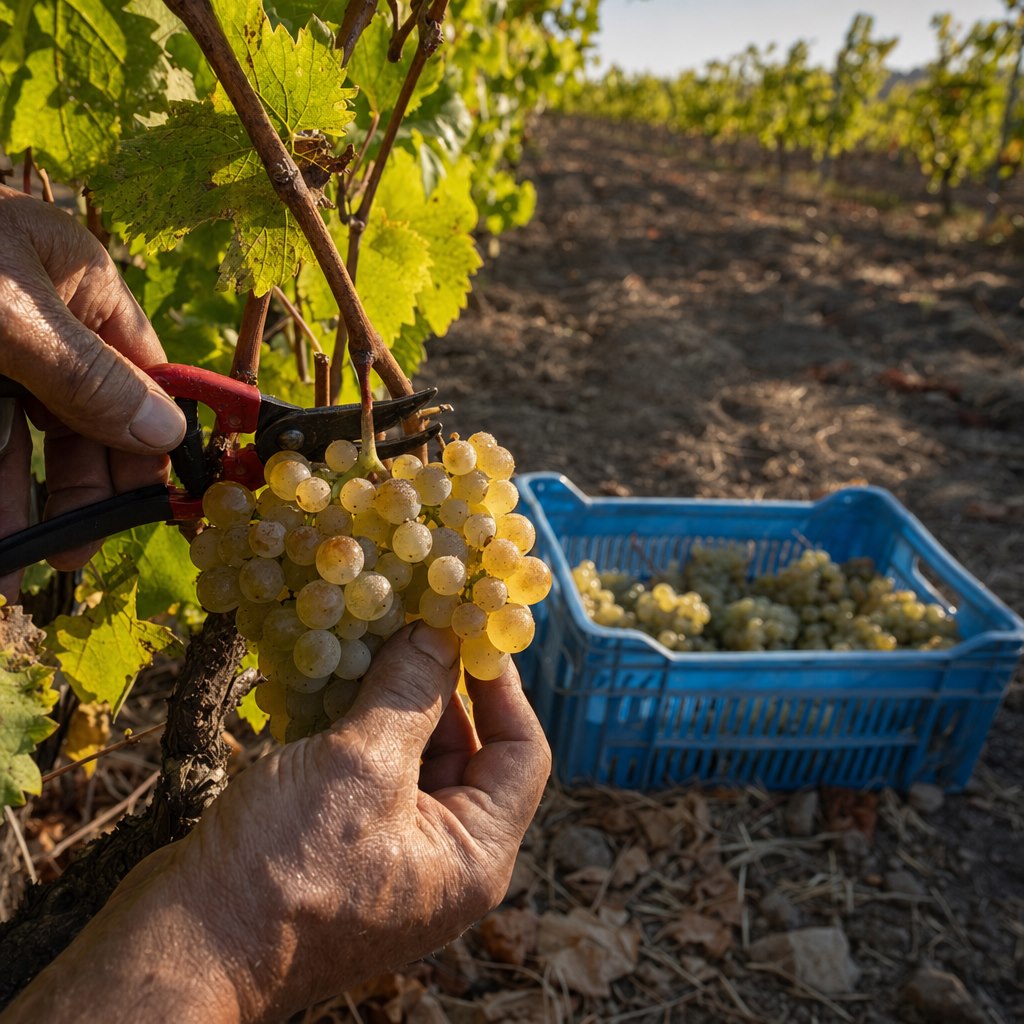
September is the month when August’s waiting turns into work. After weeks spent tasting bunches and reading the colour of the seeds, the moment comes when the decision really has to be made: we start picking. And once we have started, we do not stop until the last variety is in the cellar.
No harvest is ever the same as another. The vintage changes, the dates change, the gap between one variety and the next changes. What does not change is how we do it: by hand, variety by variety, without overlapping different pickings on the same day.
The first grapes reach the cellar
The whites open the harvest. Malvasia Puntinata is almost always first: it is the most delicate variety on the estate, it has a thin skin, and waiting too long means risking rot or losing the acidity that holds the wine together. Then comes Grechetto, which takes its time and is picked when it says so, and finally Trebbiano.
The pace of the first days is hectic. The grapes reach the cellar in full crates, they are checked and crushed. It is the moment when months of work in the vineyard and weeks of preparation in the cellar are put to the test together.
For us there is only one rule: no grapes are left waiting. Grapes picked in the morning must be in the cellar before the heat starts making them ferment on their own. The time between cutting the bunch and reaching the tank is the first factor that decides the quality of the wine, and it cannot be made up afterwards.
Picking by hand, bunch by bunch
We harvest by hand because it is the only way to truly choose what goes into the cellar and what stays behind. A machine picks everything: the good bunches, the damaged ones, the ones that are not ready yet. Whoever harvests with us sees the bunch before cutting it, and if it does not convince them, they leave it on the vine.
This is not nostalgia for the past. It is an agronomic choice: in a family-sized organic vineyard, selection at harvest is the most effective filter we have. A bunch with a few rotten berries, if it ends up in the tank, spoils everything else. A bunch cut in time and left on the ground, on the other hand, does no harm.
The work is hard. The days start early, at dawn or even before, while the temperature is still bearable, and end in the late morning before the heat becomes too much. Those who have harvested with us in other years know the pace; for those coming for the first time, our advice is to pace themselves.
The first fermentations
In the cellar, work does not stop when the vineyard rests. In fact, when there is less to do in the vineyard, there is more to do in the cellar. The first whites go into the press, the must flows down by gravity into the steel tanks, and within a few hours the fermentations start, with the starter cultures we prepared a few days before the full harvest.
We do not add selected yeasts. The yeasts that start the fermentation are the ones the grapes bring with them from the vineyard, the ones on the skins, the ones living in the cellar — which has been the same for years and has its own character. It is a slower and less predictable method, but it is consistent with how we farm the vineyard: if we do not use chemicals in the field, it makes no sense to bring them back in the cellar.
The first weeks after the harvest mean constant monitoring. Tank temperature, must density, how the fermentation is progressing: everything has to be followed every day, sometimes several times a day. Nothing runs on autopilot. A problem that arises now and is not spotted in time becomes a problem in the wine, and by then it is too late.
The reds: the wait goes on
While the whites are already in the cellar, the reds are still in the vineyard. Merlot is usually the first red to be ready, then Sangiovese and Syrah, and last of all Montepulciano, which in Santa Palomba always ripens in its own time.
In the weeks between the end of the white harvest and the start of the reds, we keep walking the vineyard and tasting. The criterion is not just sugar: it is the tannins in the skins that have to be ripe, and in a red picked too early you can taste it for the whole life of the wine.
This is when experience counts more than measurement. A refractometer tells you how much sugar there is; it does not tell you whether the tannin is ready. You find that out by biting into the skins and the seeds, and the answer changes from variety to variety.
The weather decides
September is also the month when the weather can still change everything. A sudden storm after weeks of drought swells the berries and dilutes the sugars. A few minutes of hail on the wrong vineyard ruins a year’s work. A long spell of heat speeds up the ripening of the reds more than we would like.
We watch the forecasts with the same obsessive attention as in June, but for the opposite reasons: back then we worried about downy mildew after the rain, now we worry about having to bring a picking forward to get the grapes in before an incoming front.
When the forecasts turn bad, decisions are made quickly. Better to pick a few days before the ideal point than to risk losing everything. But “quickly” does not mean without thinking: it means having plan B ready weeks in advance, and being able to put it into action without improvising.
September as the month of reckoning
At the end of September, or early October depending on the vintage, the harvest comes to an end. In the vineyard the rows are left bare, in the cellar the tanks are full. Twelve months of work, from winter pruning to harvest, take shape in something that can finally be measured, tasted and judged.
It is the month when we understand, beyond any doubt, whether the choices made in the previous months were right. A leaf-thinning mistake made in June shows in the concentration of grapes picked in September. Water stress pushed too far in July can be felt in the balance of a red that will have to age for a year. There is no going back, but we learn — and what we learn serves for next year.
Making wine in September is above all this: handing on to the future the work of the year that is coming to a close. We will only really taste the wine being born now in twelve, twenty-four, thirty-six months. But the character it will have is decided today, in these weeks, in every grape that comes into the cellar and in every choice about when and how to pick it.