
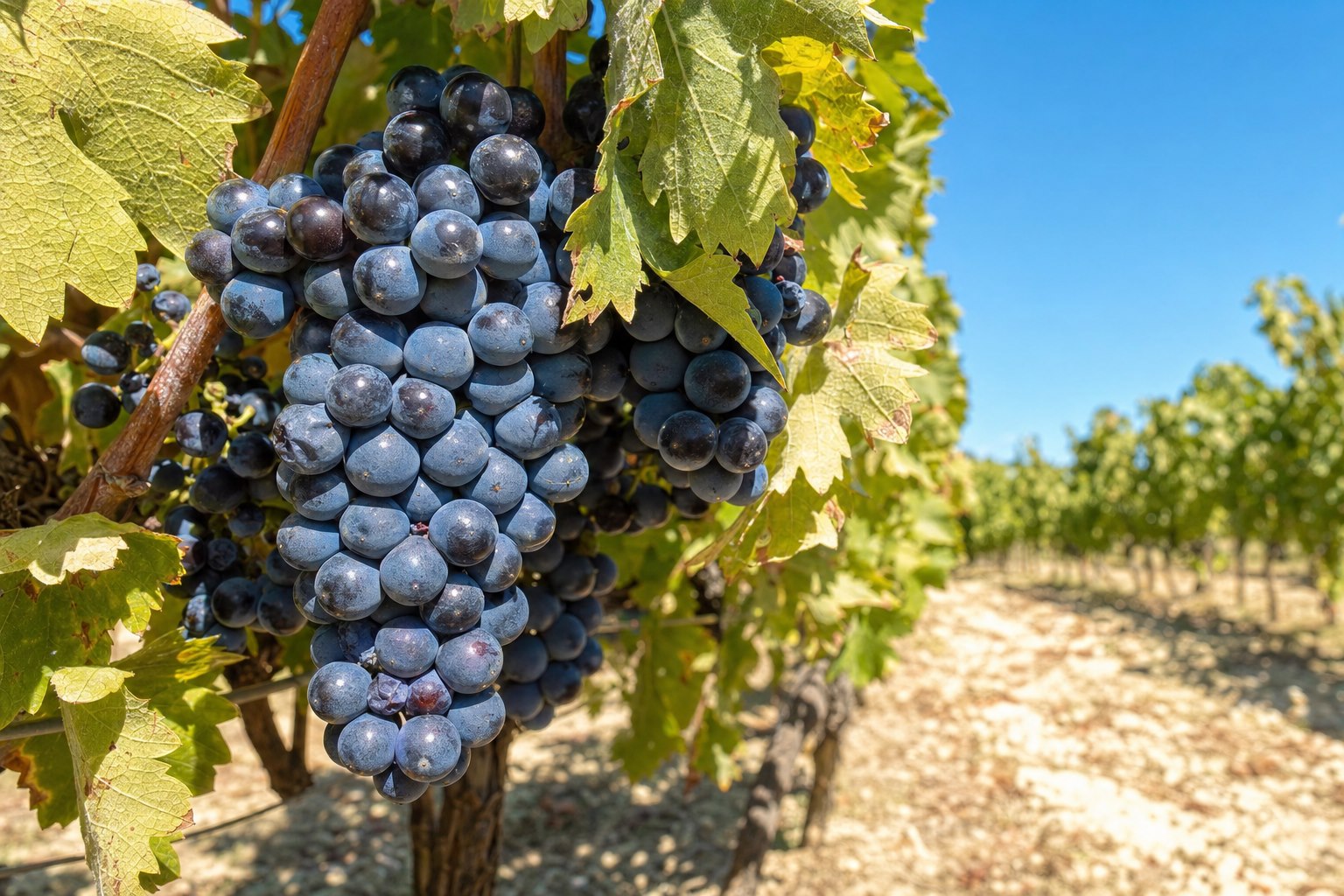
August is the month when the heat reaches its peak and the vineyard, after the rush of June and the transition of July, enters the quietest phase of the year. Veraison, still under way in July — green berries next to berries already purple in the same bunch — is completed in August. The colour is almost uniform everywhere. From here on there is only one watchword: wait.
It is not a passive wait. It is a wait that needs daily attention, even if our hands, for the first time since March, hardly touch the vines any more.
Ripening enters its final phase
With veraison complete in every variety, all of the vine’s work moves inside the berry. Sugars build up, acidity rebalances, and the tannins in the skins of the reds ripen together with the pulp. It is a process you cannot see from the outside: you can only see it by tasting.
And that is what we do, every week, walking between the rows. We take a berry, chew it, look at the colour of the seeds — when they turn from green to brown it is another sign that ripening is moving forward. We check the firmness of the skin, the elasticity of the berry, the taste of the pulp. These are hands-on checks, based on years of experience more than on instruments, although there is always a refractometer in our pocket.
Sangiovese and Syrah, the first to go through veraison, are also the ones we are most curious to taste first. Montepulciano, slower at every stage, is the one we are in the least hurry to form an opinion on. Among the whites, we watch Malvasia Puntinata above all: it is the most delicate variety on the estate, and August is the month when we understand whether the vintage will be generous or whether we will need to be stricter in the vineyard in the coming weeks.
Extreme heat and water management
If June asked for manual work and July for patience, August asks for endurance. Temperatures in Santa Palomba regularly go above thirty-five, thirty-seven degrees. Fortunately the nights bring some relief.
We still do not irrigate. It is a choice we have always held to, and August is the month when it is tested hardest. The roots, which have grown deep over the decades, still find the moisture that the pozzolanic soil holds beneath the dry surface. But the balance is more fragile than in June: if the heat goes on relentlessly for too many weeks, even a well-rooted vineyard starts to suffer.
The signs we watch for are always the same: leaves curling at the edges, shoot tips that stop growing, berries losing their firmness in the hottest hours. A little stress, as we saw in July, is a tool: it concentrates sugar and colour. Too much stress, on the other hand, shuts the vine down and harms ripening instead of helping it. You see the difference between the two by walking the vineyard every day, not by waiting for the weekly bulletin.
Little to do, a lot to observe
In the vineyard, by August, the manual work is almost over. The topping and leaf thinning done in June have already given the canopy the structure it needs for the rest of the season. If we made a few mistakes, we learn from them for the future.
It is the month when we check the health of the nearly ripe bunches most carefully. A berry with a thinner skin, as happens close to ripeness, is more vulnerable to rot if there is not enough airflow or if there are wounds — from hail, from insects, from a berry split by a sudden downpour after weeks of drought. We check bunch by bunch, especially in thin-skinned varieties such as Malvasia Puntinata.
In the cellar, preparations step up
While the pace slows in the vineyard, the opposite happens in the cellar. August is the month when we get concretely ready for the harvest, even though the picking itself is still a few weeks away.
We clean and check the steel tanks, and we test the crusher and all the equipment that in a few weeks will be working non-stop. We plan the picking order according to how ripening is progressing: the earliest whites first, then the reds as each variety reaches the right point.
August as a month of active waiting
There is no contradiction in saying that August is a quiet month and that it is a demanding one. Hands work less in the vineyard, but eyes work more. Every walk between the rows helps us understand one more piece of the picture that will lead to the most important decision of the year: when to start the harvest.
It is a wait that requires discipline, not laziness. You have to resist the temptation to pick early, and you have to recognise the moment when waiting any longer no longer serves any purpose. In between there are weeks of patient observation, daily tasting, and keeping an eye on the heat and the vines’ thirst.
Making wine in August means above all this: being ready, with nothing yet to do. It is perhaps the hardest month to explain to anyone looking from the outside — it seems as if nothing is happening, while inside every bunch the character of the vintage is being decided.